
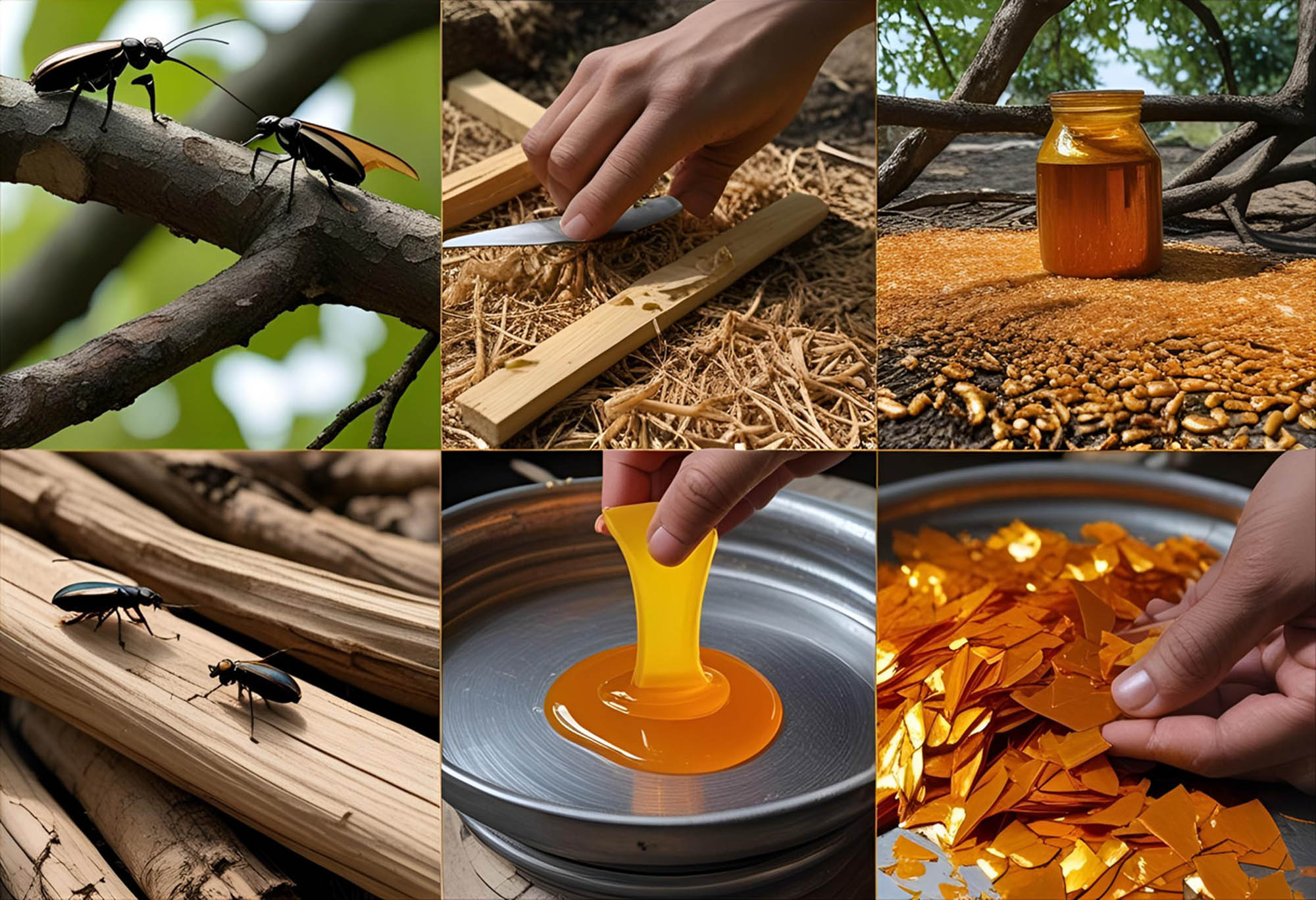
Shellac’s journey begins in the dense forests of India and Southeast Asia, where tiny insects known as Kerria lacca settle on host trees such as Palas, Ber, and Kusum. These insects secrete a resinous substance as they feed on tree sap, encrusting the branches with what is known as Sticklac. This natural process is both sustainable and fascinating—hundreds of thousands of insects are responsible for producing just one kilogram of raw lac resin.
Harvesting begins by scraping Sticklac from tree branches. This raw material contains impurities such as insect parts, bark, and dust. It’s then crushed and sieved, followed by repeated washing to remove colorants and debris. This yields a semi-purified product called Seedlac. From here, Seedlac becomes the base material for producing various types of shellac, including Dewaxed, Bleached, Hand Made, and Machine Made Shellac.
The production process can follow two primary methods: the traditional hand method or the modern machine method. In the hand-made process, Seedlac is packed into cloth bags, heated over charcoal fires, and manually filtered. The molten resin is stretched into thin sheets and broken into flakes. The machine method, more consistent and scalable, uses hydraulic presses and steam heat to melt and filter the resin, which is then rolled out and broken into flakes or buttons.
In some cases, shellac undergoes dewaxing or bleaching for specialized applications like food coatings or pharmaceuticals. This enhances purity and alters color for customer-specific needs.
Each stage—from lac insect secretion to finished shellac flakes—is a remarkable blend of nature and craftsmanship. The result is a biodegradable, renewable product used globally across industries. Understanding how shellac is made not only adds value to its use but also highlights the centuries-old knowledge and sustainable harvesting that go into its creation.


